Hi Everyone,
On my small deck overlooking the Oxford Canal between the bridges of Aristotle Lane and Walton Well Road, over the years I have added my own splash of colour: the red of geraniums, the pastel of lavenders in terracotta pots dating back to another time and place.
Each year I also toss around a packet of Henry Wilde sunflower seeds, and think good luck. These seeds have to germinate on their own, under the random hand of wind, rain, sun and soil, nature doing the work rather than me. It’s my singular way of testing creation.
This year, however, I did something different. I placed a few seeds in each of the terracotta pots along the deck and a few further back up the garden, along with my casual sunflower seed scatter. I thought that perhaps these potted seeds would have a better chance because none of the seeds I’ve strewn over the years have ever transformed into a sunflower, despite me thinking of myself as a sort of Johnny Appleseed.
And this year, it happened!
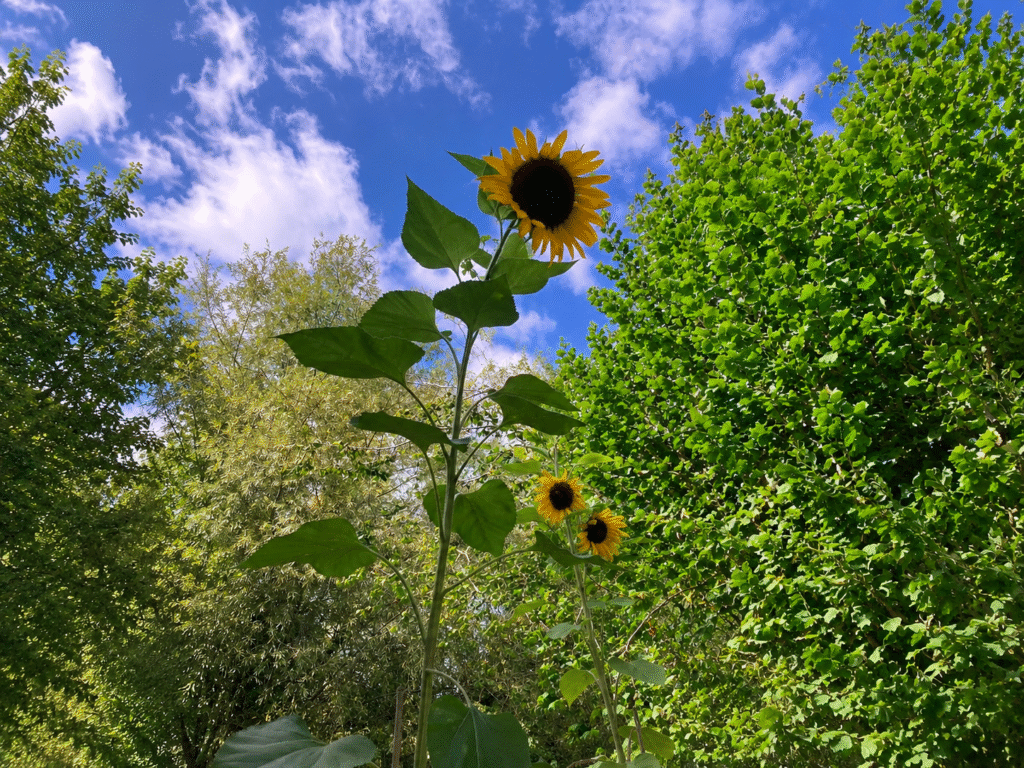
While not every seed in the pots emerged a winner, three did raise a stem, a few leaves and then a stalk. Hopping squirrels or perhaps my springy sprocker spaniel took one out immediately, and then there were two seedlings remaining.
Despite my desire to just let them have a go on their own, I could not give nature the upper hand. I was a cheerleader every step of the way, a plant whisperer even—yes, you can do it—learning to read their moods, the droop of their leaves.
When the hose pipe ban came into force as a result of the UK drought, I hand-carried water to my two by then statuesque Helianthus. No summer-long drought or a day of record-equalling 34.3 degrees Celsius would kill these sun-tracking beauties, who, now mature, permanently faced east.
Ah! Permanently?
Now, Dear Reader, you and I know this is wishful thinking. Already my mornings are cooler and there is rain at last, England is more England, I carry a brollie in the car, and my heavy Henry Wilde sunflower heads are bowing, thick with seeds and morning dew, and perhaps there is one less Apis mellifera, Western honey bee, monotonously nosing about.
I know and you know there is no permanently facing east. I am guessing, with a hint of autumn in the air, a first frost will cap the season for these majestic sunnies. It is a fact that Henry Wildes do fade; there are four, maybe five months, in the life cycle of a sunflower.
Clearly, when I wrote “permanently facing east” I meant for the botanical lifespan of the plant, but permanently for me has always meant forever. The word holds a sense of eternity, and death, the end, has never quite registered in that definition.
As I studied my drooping twins, I came to understand that the reason the once sun-following flowers were now fixed towards the morning warmth of the east-rising sun was to preserve those seeds and attract more pollinators. Nature’s way to help those big bright overblown daisies survive. Perhaps that’s where for me the forever, eternal, even biological permanently comes in.
Yes, that stable position facing east allows those seeds to ripen, fall and begin again. This sun-pointing flower stops in one position facing east to ensure its legacy.
So I guess not wishful thinking after all, and not unlike what I have seen in friends, family, even strangers, who have now passed on. Their legacy, like those seeds, endures in babies, businesses and books—permanently.
Happy September, one and all!
Love,